

You wrote "£10k months" on a Post-it in January. You meant it. For two weeks you posted daily, chased rebookings, blocked out admin time.
Then a busy clinic week swallowed it whole. The Post-it's still on the fridge. The diary still has gaps. And somewhere in your head, a quiet voice is telling you that you're just "not a business person."
You are. You're just relying on motivation instead of machinery.
Here's the truth most solo practitioners learn the hard way: goals are nothing without robust systems. A goal points at where you want to go. A system is what actually carries you there on the weeks you've got no spare brain left. As a one-person clinic, the system is the job.

Why do solo practitioners' goals keep dying?
Because the goal lives in your head and nowhere else.
There's no manager, no quarterly review, no one asking "how's that going?" You are the owner, the marketer, the injector, the cleaner and the accountant - and the business-owner hat is the one that slips off first when you're knackered.
When everything depends on you remembering to care, the clinical work always wins. It's urgent and someone's in front of you. Growth work is important but never urgent, so it quietly never happens.
The fix isn't more willpower. It's taking the decisions out of your head and putting them somewhere external and repeatable. Ideally automated.
How do I set goals that actually mean something for my clinic?
Vague goals are comfortable because you can never fail them. "Grow the business" can't be missed - or hit. Make it specific enough to be measurable, then break it down.
Start with one anchor number for the year, usually revenue. Say you want to turn over £90,000 (worth knowing: that's also the current VAT registration threshold, so it's a number to plan around deliberately, not stumble past…that will bit you on the ass). Now reverse-engineer it:
£90,000 ÷ 12 = £7,500 a month
At an average treatment value of, say, £250, that's 30 treatments a month - roughly 7–8 a week
If your rebooking rate is poor, you need far more new patients to hit that. If your rebooking rate is strong, your existing patients carry most of it.
Suddenly "grow the business" becomes "I need 7-8 booked treatments a week and a rebooking rate above 70%." That you can actually manage.
Set goals across three areas, not just money:
Revenue & profit - turnover, margin, average treatment value
Patients - new enquiries, conversion rate, rebooking/retention rate, patient lifetime value (LTV - typically £2,000-£5,000+ for a well-run clinic)
You - clinic days, admin hours, time off, training, rest, family time. A business that burns you out isn't a successful one.
Which numbers should I actually track?
The mistake is only watching the money - that's a lagging indicator. By the time it's bad, the damage is already done. You want leading indicators: the activities that cause revenue, that you can influence this week.
Lagging = the score: monthly revenue, profit, total patients.
Leading = the levers: number of booked appointments, enquiry-to-booking conversion rate, rebooking rate at point of treatment, posts published, reviews received, recall messages sent.
If your revenue goal is slipping, you don't stare at the lagging number - you look at which lever stopped moving. Usually it's rebooking or follow-up that quietly fell off.
How do I hold myself accountable when I'm the only one in the business?
You build the accountability into the week so it doesn't depend on motivation. Three systems do most of the work:
A weekly 30-minute CEO slot. Same time every week, in the diary, as non-negotiable as a patient appointment. You review the last week, look at the week ahead, and pick the one growth task that matters most. Not ten. One.
A monthly numbers review. An hour at month-end to update your tracking spreadsheet and compare against the plan. Where are you vs the £7,500? What's working well? What’s not? Adjust.
A quarterly reset. Every 90 days, zoom out. What worked over the quarter, what to drop, what the next quarter's target. Quarters beat annual goals — they're long enough to move a number, short enough that you can't coast.
External accountability multiplies all of this.
A peer practitioner you check in with monthly, a mentor, or a paid accountability call will do more for your follow-through than any planner. Saying your goal out loud to someone who'll ask about it next month is one of the cheapest growth tools there is. There’s nothing quick like the shame of not delivering something to motivate you!

A simple 90-day rhythm you can copy
Pick one anchor goal for the quarter (e.g. lift rebooking rate from 55% to 70%).
Identify the one or two leading levers that move it (offer a rebook at every appointment; send a monthly newsletter to your regulars).
Build the lever into a system so it happens without you deciding - a Claude agent to draft your monthly email for you, a recall workflow, a default question at checkout, an automated reminder.
Track weekly in your CEO slot.
Review at 90 days, then reset.
Notice that the goal lives in your systems and your software, not in your head. That's the whole point. A solo practitioner who automates rebooking reminders and patient recalls will out-grow a far busier one who's relying on memory and a Post-it — every single time.
Three worked examples
The rhythm is always the same five steps: pick one anchor goal, identify the one or two leading levers that move it, build those levers into a system so they happen without you deciding, track weekly in your CEO slot, then review and reset at 90 days.
Here's what that looks like across three goals you might realistically set.
Example 1: Lift your rebooking rate from 55% to 70%
The maths: retention is the cheapest growth there is. Keeping an existing patient costs a fraction of acquiring a new one, and your whole LTV depends on it.
Anchor goal: rebooking rate from 55% to 70% over the quarter.
Leading levers: offer a rebook at every appointment, and send a recall message at the right interval after treatment.
Build it into a system: make "book the next appointment" a default step at checkout, and set an automated recall workflow so no one slips through.
Track weekly: % of patients leaving with their next appointment booked.
Review at 90 days: if the rate's stuck despite offering every time, your recall timing is probably off, not your patients.
Example 2: Lift your average treatment value from £200 to £260
The maths: if you treat 30 patients a month, adding £60 to your average visit is £1,800 a month — £21,600 a yearwithout seeing a single extra patient. Same diary, same hours, more revenue. This is the most overlooked lever solo practitioners have.
Anchor goal: raise average treatment value from £200 to £260 over the quarter.
Leading levers: present a treatment plan (not a single treatment) at every consultation, and introduce a relevant add-on or skin-journey step where it's genuinely indicated.
Build it into a system: make a treatment plan the default output of every consultation — not "would you like anything else," but a documented plan showing where this patient is heading over 6–12 months. Set a standard recommendation framework so you're not deciding from scratch each time.
Track weekly: average treatment value, and the % of patients who left with a plan rather than a one-off.
Review at 90 days: is the average climbing? If patients are accepting plans but the number isn't moving, your pricing or your sequencing is the issue, not your patients.
The honest caveat: this only works ethically if every recommendation is clinically right for that patient. Up-selling a treatment someone doesn't need isn't a growth strategy — it's a complaint and a reputation risk waiting to happen. Plan around what's genuinely best for their skin, and the value rises as a by-product.
Example 3: Generate 8 new consultation bookings a month
The maths: new patients replace natural drop-off and grow the business. If 8 consultations a month convert at 60%, that's roughly 5 new patients monthly — 60 a year. And because each one carries an LTV of £2,000–£5,000+, that single quarter's habit compounds into serious money. Here's how the lifetime value of those patients stacks up over a year of consistency:
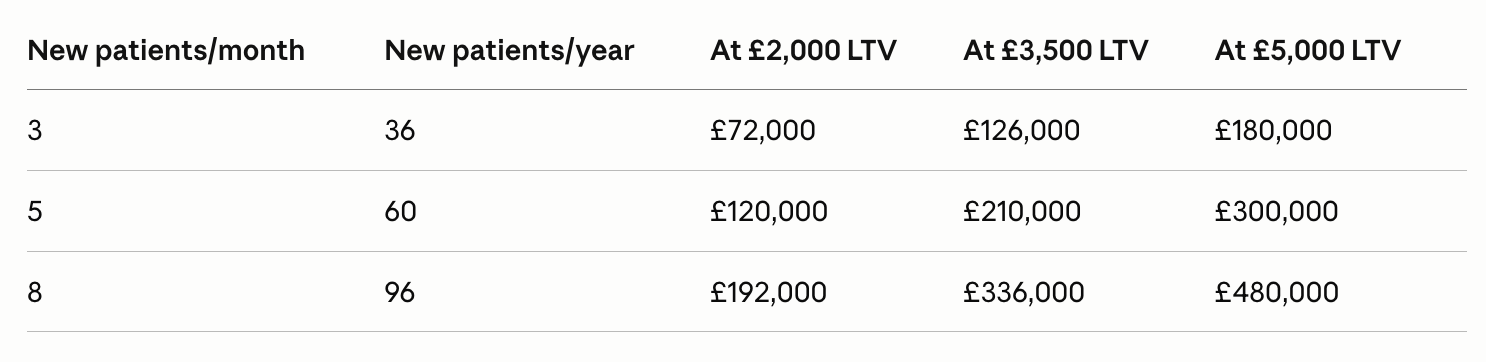
LTV is the total revenue a patient brings over the whole time they stay with you — not their first visit. It's why one month's acquisition habit is worth far more than one month's takings.
Anchor goal: 8 booked consultations a month (24 over the quarter).
Leading levers: consistent content that drives enquiries, and a fast, frictionless booking route so interest doesn't leak away. Most lost bookings die in the gap between "I'm interested" and "I've booked."
Build it into a system: batch a month of content in one sitting rather than scrambling daily, set a rule to request a review and a referral from every happy patient, and make your booking link one tap from every post and profile.
Track weekly: enquiries received and consultations booked — leading numbers you can act on long before they show up in revenue.
Review at 90 days: if enquiries are healthy but bookings are low, your booking process is leaking. If enquiries are low, your visibility is the problem. The numbers tell you which lever to pull.
The reframe: patients don't just arrive — they're acquired, and acquisition is a system, not luck. A solo practitioner with a reliable monthly content-and-booking rhythm will never have the "feast or famine" diary that catches everyone who waits for word of mouth.
Notice that in all three, the goal lives in your systems and your software, not in your head. That's the whole point. A solo practitioner who automates rebooking reminders and patient recalls will out-grow a far busier one who's relying on memory and a Post-it — every single time.
Frequently asked questions
What's a realistic first-year revenue goal for a solo aesthetics business? It varies hugely with hours, location and pricing, but many solo practitioners build toward the £60,000–£90,000 turnover range as they fill the diary. Plan around the £90,000 VAT threshold deliberately rather than crossing it by accident.
How is a goal different from a system? A goal is the outcome you want (a 70% rebooking rate). A system is the repeatable process that produces it (an automated recall sent at the right interval after every treatment). Goals set direction; systems do the work.
What's the single most important number to track as a solo practitioner? Rebooking/retention rate. Acquiring a new patient costs far more than keeping an existing one, and your patient lifetime value depends almost entirely on whether they come back. Aim for 70%+.
How often should I review my business goals? Lightly every week (a 30-minute CEO slot), properly every month against your numbers, and a full reset every quarter. Annual-only goals are too far away to course-correct.
I'm too busy treating patients to do "business" tasks — what do I do? That's the exact problem systems solve. Automate the repeatable growth work — rebooking reminders, recalls, review requests — so it runs without your attention, and protect one short weekly slot for the decisions only you can make.
Want to read more?
How to price your treatments for profit
Patient retention and rebooking for clinics
Patients don't just arrive, they are acquired
Your goals are only as good as the systems behind them.
GlowdayPRO is built to be that system - automated rebooking reminders and recalls so retention happens without you chasing it, and a bookable Glowday profile that keeps new patients flowing in.